Drive systems & mechanisms
Engineering Science · National 5 · mrkellydt.co.uk
What you're learning in this topic
Learning intention WALT
We are learning about drive systems & mechanisms, specifically to:
know
- the four types of motion and give examples
understand
- the effect of an idler gear
- ways to reduce friction and wear
be able to
- calculate velocity ratio and output speed in gear trains
- design a compound gear train to give a required speed
Success criteria WILF
- I can name the four types of motion and give examples
- I can calculate velocity ratio and output speed in gear trains
- I can describe the effect of an idler gear
- I can design a compound gear train to give a required speed
- I can describe ways to reduce friction and wear
Types of motion
A mechanism changes an input motion and force into a different output motion and force: it makes a job easier. Learn the four motions and their British Standard symbols.
- Rotary: turning in a circle (a wheel).
- Linear: in a straight line (a conveyor belt load).
- Reciprocating: backwards and forwards in a straight line (a pneumatic piston, a saw).
- Oscillating: swinging backwards and forwards in an arc (a pendulum, a windscreen wiper).
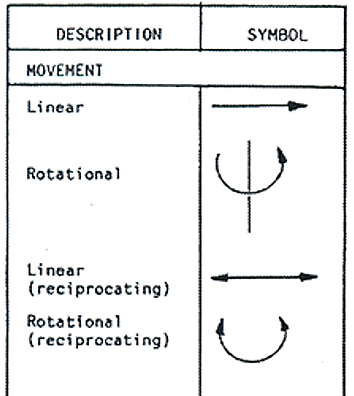
Gear trains
- In a simple gear train meshing gears turn in opposite directions.
- Velocity ratio VR = speed of input ÷ speed of output = teeth on driven gear ÷ teeth on driver gear. A VR of 4:1 means the output turns 4 times slower.
- Speed method: input speed × input teeth = output speed × output teeth. E.g. 1500 × 52 = output × 12, so output = 6500 revs min⁻¹.
- An idler gear between driver and driven makes them turn in the same direction. It doesn't change the velocity ratio, whatever its size: changing its number of teeth has no effect on the output speed.
- A compound gear train has two gears fixed on the same shaft, giving a large speed change in a small space. Total VR = VR1 × VR2.
Write speeds in revs min⁻¹ (not "RPM") and simplify ratios, e.g. 120:820 = 6:41. The 2024 N5 report: candidates using the data booklet speed method scored better on compound trains than those juggling ratios.
Speeds, units and compound trains
- The input gear is the driver; the output gear is the driven.
- Rotary speed is measured in revolutions per minute: revs min⁻¹.
- VR = teeth on driven ÷ teeth on driver = input speed ÷ output speed. The SQA calls it the velocity ratio (or speed ratio). Example: driver 14T, driven 72T: VR = 72 ÷ 14 = 5.1, so a 100 revs min⁻¹ input gives about 19 revs min⁻¹.
- A small driver with a large driven reduces speed; a large driver with a small driven increases it.
- An idler makes the driven turn the same way as the driver. Its size has no effect on speed, so idlers are kept small to save space and material.
- In a compound gear train two gears share one shaft and turn at the same speed. Total VR = VR of pair 1 × VR of pair 2. Example: A 20T drives B 60T; C 10T (on B's shaft) drives D 80T: VR = 3 × 8 = 24, so 100 revs min⁻¹ in gives 4.2 revs min⁻¹ out.
- Compound trains give a large VR in a compact space, with fewer and smaller gears than a simple train.
Interactive simulation: try this on the revision site, where you can change the values and see the result.
Worked examples: gear trains
1. Simple train. A 12-tooth motor gear turning at 1500 revs min⁻¹ drives a 48-tooth gear. Find the output speed and direction.
Input speed × input teeth = output speed × output teeth → 1500 × 12 = output × 48 → output = 18 000 ÷ 48 = 375 revs min⁻¹, in the opposite direction. (VR = 48 ÷ 12 = 4:1.)
2. With an idler. A 20-tooth idler is added between the two gears. The output speed is still 375 revs min⁻¹, but the output now turns the same way as the motor. The idler's size makes no difference.
3. Compound train. A (15T) drives B (45T). C (10T) is fixed to B's shaft and drives D (50T). A turns at 600 revs min⁻¹.
- B: 600 × 15 = B × 45 → B = 200 revs min⁻¹. C is on the same shaft, so C = 200 revs min⁻¹.
- D: 200 × 10 = D × 50 → D = 40 revs min⁻¹.
- Check with VR: total VR = (45 ÷ 15) × (50 ÷ 10) = 3 × 5 = 15, and 600 ÷ 15 = 40 ✓. D turns the same way as A (two meshes).
Show each line of working: the 2024 N5 report noted that candidates who set out the speed method step by step scored more marks on compound trains.
Friction
In a gear system the meshing teeth rub, turning kinetic energy into heat and sound. Heat makes parts expand, increasing wear and damage, and the lost energy reduces efficiency. Reduce friction with oil or grease, bearings (which change rubbing into rolling), and regular maintenance to replace worn parts.
Friction is not always a problem: it is useful in brakes, clutches and belt drives, where it lets one surface grip another.
Design challenge: stage curtain winch
The brief. A theatre in Glasgow needs a hand-cranked winch to raise a heavy curtain. The handle can turn at 60 revs min⁻¹ and the drum must turn at 4 revs min⁻¹.
- Calculate the velocity ratio needed.
- Design a compound gear train to give this VR using gears between 10 and 60 teeth.
- Calculate the drum speed to check your design.
- Explain how friction could be reduced in the winch.
What a good answer includes
- VR = 60 ÷ 4 = 15.
- e.g. 10T driving 30T (VR 3), then 10T driving 50T (VR 5): 3 × 5 = 15.
- 60 × 10 = B × 30 → 20; 20 × 10 = D × 50 → 4 revs min⁻¹ ✓.
- Lubricate the gears and fit bearings on the shafts.
Key terms
| Reciprocating motion | Backwards and forwards in a straight line. |
|---|---|
| Oscillating motion | Swinging backwards and forwards in an arc. |
| Velocity ratio | Speed of input ÷ speed of output = driven teeth ÷ driver teeth. |
| Gear speed method | Input speed × input teeth = output speed × output teeth. |
| Idler gear | Makes driver and driven turn the same way; doesn't change the VR. |
| Compound gear train | Two gears on one shaft; total VR = VR1 × VR2. |
Quick check
1. A pneumatic piston moving in and out shows…
- Rotary motion
- Reciprocating motion
- Oscillating motion
- Linear only
Show answer
2. A 20-tooth driver turns a 60-tooth gear. The VR is…
- 1:3
- 20:1
- 3:1
- 60:1
Show answer
3. Reducing the teeth on an idler gear makes the output…
- Faster
- Slower
- Turn the other way
- No different
Show answer
4. A 1500 revs min⁻¹, 52-tooth gear drives a 12-tooth gear. Output speed is about…
- 6500 revs min⁻¹
- 346 revs min⁻¹
- 1500 revs min⁻¹
- 780 revs min⁻¹
Show answer
Printable worksheet
An I do, we do, you do worksheet for this topic, with a separate answer sheet.