Pneumatics
Engineering Science · Higher · mrkellydt.co.uk
What you're learning in this topic
Learning intention WALT
We are learning about pneumatics, specifically to:
know
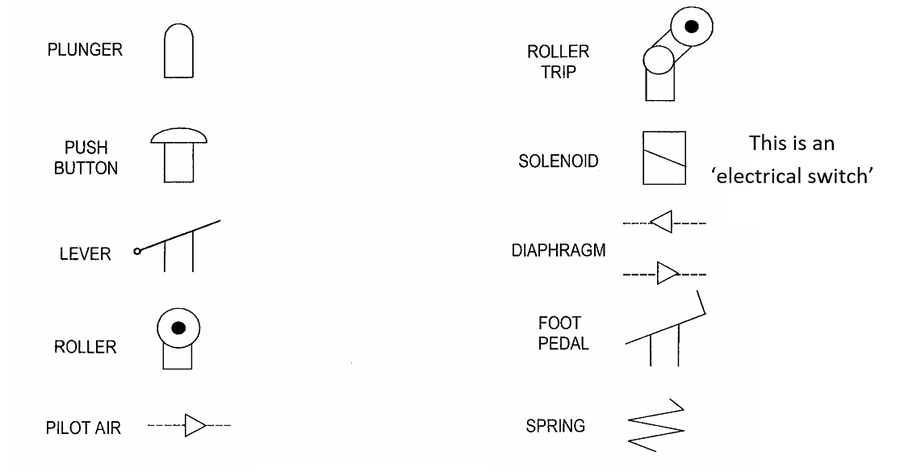
- pneumatic components and draw their symbols
- AND and OR control in pneumatic circuits
- environmental reasons for choosing pneumatics
understand
- circuits with the correct terms: actuate, change state, outstroke, instroke
- speed control and time delays with restrictors and reservoirs
- sequential and electro-pneumatic circuits
be able to
- calculate force, pressure and area in N/mm²
Success criteria WILF
- I can name pneumatic components and draw their symbols
- I can describe circuits with the correct terms: actuate, change state, outstroke, instroke
- I can identify AND and OR control in pneumatic circuits
- I can calculate force, pressure and area in N/mm²
- I can describe speed control and time delays with restrictors and reservoirs
- I can describe sequential and electro-pneumatic circuits
- I can give environmental reasons for choosing pneumatics
Components
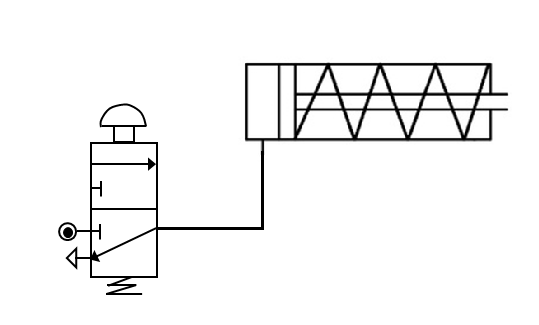
- Single-acting cylinder: air outstrokes the piston; a spring returns it.
- Double-acting cylinder: air drives the piston both out and in.
- 3/2 valve: 3 ports, 2 states. Actuated by push button, lever, roller, plunger, solenoid, diaphragm (low-pressure signal from an air bleed) or pilot air; usually spring return.
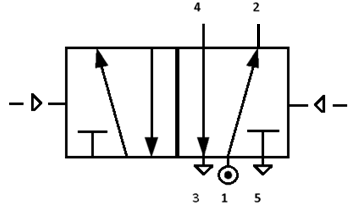
- 5/2 valve: 5 ports, 2 states; controls a double-acting cylinder. Often pilot-air operated in both directions, so it stays in its last state (memory).
- Restrictor and uni-directional restrictor (UDR): control air flow. A UDR restricts flow one way only.
- Reservoir: a tank that takes time to fill; with a restrictor it gives a time delay.
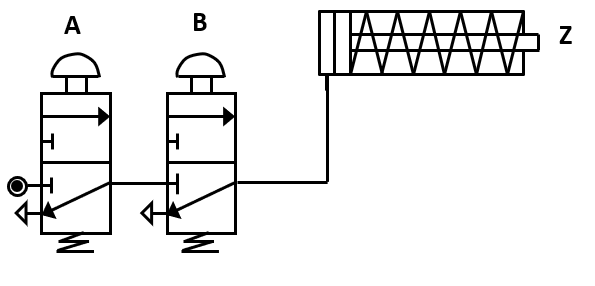
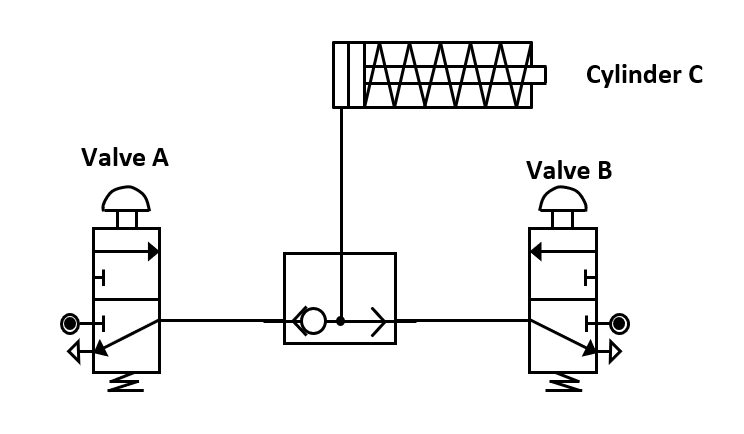
- Shuttle valve: OR control. Two valves in series: AND control.
Why pneumatics?
- Advantages: air is clean, so leaks don't contaminate food or medicine production; no sparks, so it is safe in flammable or explosive areas; fast, reliable and low cost to maintain; a cylinder can stall under overload without damage.
- Disadvantages: needs a compressor; the exhaust is noisy; air compresses, so positions are less precise and forces are smaller than in hydraulics; leaks waste energy.
- Safety: wear eye protection, switch the air off before changing a circuit, and never point compressed air at anyone.
Describing pneumatic circuits
Use the correct words: 3/2 valves actuate, 5/2 valves change state, pistons outstroke and instroke. E.g. "Valve 2 is actuated, so pilot air changes the state of valve 3 and cylinders A and B outstroke. Piston B actuates valve 4; pilot air changes valve 3 back and both cylinders instroke." All three course reports (2024–2025) criticised vague terms here.
Interactive simulation: try this on the revision site, where you can change the values and see the result.
Semi-automatic and fully automatic circuits
- Semi-automatic: a push-button valve starts one cycle. Pilot air changes the state of the 5/2 valve and the piston outstrokes; at the end of its stroke it actuates a roller trip valve, which changes the 5/2 valve back, and the piston instrokes. The user must press again to repeat.
- Fully automatic: a roller trip at each end of the stroke, so the piston keeps outstroking and instroking until the air is switched off or a stop valve is used.
- A T-piece splits one air line into two, e.g. to send main air to two valves.
Speed control and time delays
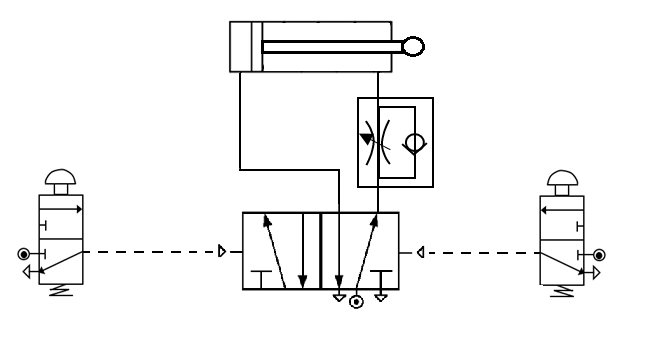
- To slow a piston, restrict the exhaust air leaving the cylinder, using a UDR in the exhaust line or a restrictor on the 5/2 valve's exhaust port. Restricting exhaust gives smoother, more controlled movement.
- A time delay: a UDR feeding a reservoir before a pilot or diaphragm-operated valve. The smaller the restriction or the bigger the reservoir, the longer the delay.
Design challenge: parcel sorter
The brief. A delivery depot in Livingston needs a pneumatic pusher to move parcels onto a side conveyor. It must push slowly, wait 2 seconds, then return automatically.
- Name the type of cylinder and main control valve.
- Explain how the pushing speed could be controlled.
- Explain how the 2-second delay could be created.
- Describe the operation of the circuit using correct terms.
What a good answer includes
- A double-acting cylinder controlled by a 5/2 valve, operated by pilot air.
- A uni-directional restrictor restricting the exhaust air.
- A restrictor and reservoir on the pilot line to the 5/2 valve.
- Valve 1 is actuated, pilot air changes the state of the 5/2 valve, the piston outstrokes; the roller trip is actuated, the reservoir fills, then pilot air changes the state back and the piston instrokes.
Force, pressure and area
- P = F ÷ A. Area of a piston A = π d² ÷ 4.
- On the instroke of a double-acting cylinder, air pushes on the piston minus the rod: effective area = piston area − rod area. Square each diameter first, then subtract.
- Work in N/mm² with areas in mm². Don't convert to m² unless asked: a 2025 error was giving N/m² without converting.
- Don't use the diameter directly in P = F/A; calculate the area first.
Pressure in bar and worked examples
- 1 bar = 0.1 N/mm², so 3 bar = 0.3 N/mm² and 0.5 N/mm² = 5 bar.
- Force: a 40 mm cylinder at 3 bar: A = π × 20² = 1257 mm², F = 0.3 × 1257 = 380 N.
- Pressure: 454 N from a 34 mm piston: A = π × 34² ÷ 4 = 907.9 mm², P = 454 ÷ 907.9 = 0.50 N/mm² = 5 bar.
- Diameter: 400 N at 5 bar: A = F ÷ P = 400 ÷ 0.5 = 800 mm²; d = √(4A ÷ π) = √(3200 ÷ π) = 32 mm.
- Instroke of a double-acting cylinder: piston 25 mm, rod 10 mm, 0.4 N/mm²: A = π × 12.5² − π × 5² = 412 mm², F = 0.4 × 412 = 165 N.
- A single-acting cylinder's instroke is driven by its return spring, so you can't change its force with air pressure.
- To increase the force: increase the pressure or use a larger piston.
Sequential and electro-pneumatic control HIGHER
Higher circuits sequence up to three cylinders: each cylinder's piston actuates a roller valve that triggers the next step, with time delays where needed. Faults to look for: a pilot valve where a diaphragm actuator is needed (air bleed), a time delay connected the wrong way round (UDR and reservoir swapped), or a missing delay between steps. In electro-pneumatic systems, solenoid-actuated valves are switched by a microcontroller, so the sequence is set in software.
Writing and describing a sequence HIGHER
Write the order using + for outstroke and − for instroke. A furnace loader: cylinder A raises the door by instroking, B pushes the block in and comes back, then A closes the door: Start, A−, B+, B−, A+, Stop.
- Each movement ends by actuating a roller trip valve that pilots the next 5/2 valve to change state.
- Describe the circuit stage by stage: "Valve A is actuated and changes the state of valve B, so cylinder A instrokes. When fully instroked it actuates valve C, which changes the state of valve D, so cylinder B outstrokes…"
- Add a time delay (restrictor and reservoir) where a step needs a pause, e.g. to let a part cool.
Key terms
| Semi-automatic circuit | One cycle per press: a roller trip returns the piston. |
|---|---|
| Fully automatic circuit | Roller trips at both ends keep it cycling. |
| A+ / A− | Cylinder A outstrokes / instrokes. |
| Single-acting cylinder | Air outstrokes; a spring instrokes. |
| Double-acting cylinder | Air drives the piston both ways. |
| 3/2 valve | 3 ports, 2 states; "actuated". |
| 5/2 valve | 5 ports, 2 states; "changes state"; controls a double-acting cylinder. |
| Uni-directional restrictor | Restricts air flow in one direction only. |
| Pneumatic time delay | A restrictor feeding a reservoir before a pilot valve. |
| Slowing a piston | Restrict the exhaust air. |
| AND control | Two valves in series. |
| OR control | A shuttle valve. |
| Pressure | P = F ÷ A (N/mm²) |
| Effective area on the instroke | Piston area − rod area. |
Quick check
1. A circuit that keeps the piston going in and out until the air is switched off is…
- Semi-automatic
- Time delay
- Manual
- Fully automatic
Show answer
2. Which is an advantage of pneumatics?
- No sparks, so safe near flammable materials
- Very precise positioning of the piston
- Completely silent when it operates
- Larger forces than a hydraulic system
Show answer
3. The sequence Start, A−, B+, B−, A+ means cylinder A first…
- Outstrokes
- Instrokes
- Stays still
- Exhausts
Show answer
4. How many ports and states does a 5/2 valve have?
- 5 states, 2 ports
- 2 ports, 5 states
- 5 ports, 2 states
- 3 ports, 2 states
Show answer
5. To slow a piston smoothly you should restrict…
- The supply air
- The reservoir
- The pilot air
- The exhaust air
Show answer
6. Two valves piped in series give…
- AND control
- OR control
- NOT control
- A time delay
Show answer
7. A 12 mm diameter piston: area is about…
- 452 mm²
- 113 mm²
- 37.7 mm²
- 144 mm²
Show answer
8. The correct way to describe a 5/2 valve operating is…
- It actuates
- It outstrokes
- It changes state
- It opens
Show answer
Printable worksheet
An I do, we do, you do worksheet for this topic, with a separate answer sheet.