Materials, stress & strain
Engineering Science · Higher · mrkellydt.co.uk
What you're learning in this topic
Learning intention WALT
We are learning about materials, stress & strain, specifically to:
know
- a stress–strain graph: limit of proportionality, yield, UTS, break
understand
- a material from a data table
- how strain gauges are used to measure strain
be able to
- calculate direct stress and strain
- calculate Young's modulus
- calculate factor of safety and strain energy
Success criteria WILF
- I can choose and justify a material from a data table
- I can calculate direct stress and strain
- I can calculate Young's modulus
- I can label a stress–strain graph: limit of proportionality, yield, UTS, break
- I can calculate factor of safety and strain energy
- I can explain how strain gauges are used to measure strain
Choosing materials
Select from a table of properties and justify with properties linked to the job: "Material C, because it is corrosion resistant, so it won't degrade in sea water, and has high strength, so it resists the forces on the mast." "Strong" alone doesn't score.
Stress and strain
- Direct stress σ = F ÷ A, in N/mm² (force in N, area in mm²). E.g. 26 000 N on a 710 mm² cable: σ = 37 N/mm².
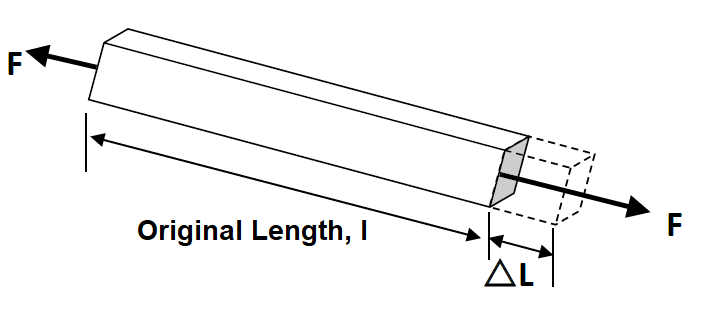
- Strain ε = Δl ÷ l: change in length ÷ original length. It has no units. E.g. 0.00036 = Δl ÷ 120 gives Δl = 0.043 mm.
- A bigger force on the same area gives a bigger stress; a bigger area reduces stress.
Stress and strain worked examples
- Rectangular bar 180 × 120 mm with 500 N: A = 21 600 mm², σ = 500 ÷ 21 600 = 0.023 N/mm².
- Wire diameter to carry 8 kN at no more than 200 N/mm²: A = 8000 ÷ 200 = 40 mm²; d = √(4 × 40 ÷ π) = 7.1 mm (round up for safety).
- Strain: a 4.0 m wire stretches 2.5 mm: ε = 2.5 ÷ 4000 = 0.000 63 (no units). Put both lengths in the same units first.
- Change in length: ΔL = ε × L = 0.0075 × 2500 mm = 19 mm.
Design challenge: climbing wall anchor
The brief. An outdoor centre in Aviemore needs a steel tie rod that will carry 12 kN without the stress going above 150 N/mm².
- Calculate the minimum cross-sectional area.
- Calculate the minimum diameter of the rod.
- The rod is 400 mm long and stretches 0.3 mm. Calculate the strain.
- Justify the choice of material.
What a good answer includes
- A = F ÷ σ = 12 000 ÷ 150 = 80 mm².
- A = πd² ÷ 4 → d = √(4 × 80 ÷ π) = 10.1 mm, so use the next size up.
- ε = 0.3 ÷ 400 = 0.00075 (no units).
- Steel is strong in tension and tough; galvanise it to stop it corroding outdoors.
Stress–strain graphs and properties HIGHER
- Limit of proportionality: up to here stress is proportional to strain (straight line).
- Elastic limit: below this the material returns to its original length when the load is removed (elastic).
- Yield point: the material starts to stretch permanently (plastic deformation).
- Ultimate tensile stress (UTS): the maximum stress before it necks and breaks.
- Properties: brittle (breaks with little deformation, e.g. cast iron, glass); ductile (can be drawn out into wire); malleable (can be hammered or pressed into shape); elastic; plastic; strength.
Young's modulus, factor of safety and strain energy HIGHER
- Young's modulus E = σ ÷ ε (N/mm²): the stiffness of a material, from the straight part of the graph.
- Factor of safety = UTS ÷ working stress. Working stress = UTS ÷ FoS. Engineers use a FoS to allow for flaws in materials, unexpected loads, corrosion and wear, and inaccuracy in calculations.
- Strain energy Es = ½ F x (J), with x the extension in m.
- Finding a size: area = force ÷ working stress, then d = √(4A ÷ π). For a tube, outer area = load-bearing area + inner area, then outer diameter, then thickness = (D − d) ÷ 2.
Why structures fail HIGHER
- Overloading: a load bigger than the design load raises the stress above the material's strength.
- Material or joint failure: flaws in the material, poor welds or failed fixings.
- Fatigue: repeated loading and unloading (vibration, traffic, wind) makes cracks grow, so a part can fail at a stress well below its UTS.
- A factor of safety allows for all of these. Typical values are higher where failure would put lives at risk (lifts, cranes) or loads are uncertain.
- Material data such as UTS and Young's modulus is read from tables in the data booklet: use the right row and check the units.
Strain gauges HIGHER
A strain gauge's resistance increases when stretched. It is bonded to a structure and wired into a bridge with a second, passive (dummy) gauge that isn't strained. The passive gauge cancels resistance changes caused by temperature, so only strain is measured. The bridge output feeds a difference amplifier.
Key terms
| Fatigue | Failure from repeated loading, below the UTS. |
|---|---|
| Stress | σ = F ÷ A (N/mm²) |
| Strain | ε = Δl ÷ l (no units) |
| Justifying a material | Name the property and link it to the job. |
| Young's modulus | E = stress ÷ strain |
| Factor of safety | UTS ÷ working stress |
| Strain energy | Es = ½ F x |
| Elastic limit | Below it the material returns to its original length. |
| Yield point | Where permanent (plastic) deformation begins. |
| Brittle | Breaks with little or no plastic deformation. |
| Ductile | Can be drawn out into a wire. |
| Passive strain gauge | Cancels temperature effects in a bridge. |
Quick check
1. A part that fails after millions of small load cycles, below its UTS, has failed by…
- Fatigue
- Overloading
- Corrosion
- Creep
Show answer
2. A 1152 N force on 36 mm² gives a stress of…
- 41 472 N/mm²
- 32 N/mm²
- 0.031 N/mm²
- 1188 N/mm²
Show answer
3. Strain has units of…
- N/mm²
- mm
- None
- N
Show answer
4. Which justification scores?
- It is strong, so it is a good choice for the boat
- It is low cost and easy for the builder to get hold of
- It is a good material that will last a long time
- It is corrosion resistant, so it won't degrade in sea water
Show answer
5. UTS 430 N/mm² with a factor of safety of 3 gives a working stress of about…
- 143 N/mm²
- 1290 N/mm²
- 433 N/mm²
- 3 N/mm²
Show answer
6. A material that breaks with almost no plastic region is…
- Ductile
- Brittle
- Malleable
- Elastic
Show answer
7. Why use a passive strain gauge?
- To double the reading
- To power the bridge
- To cancel temperature effects
- To measure force directly
Show answer
Printable worksheet
An I do, we do, you do worksheet for this topic, with a separate answer sheet.